

Why NestJS?
The case for NestJS over other Node.js web frameworks and backend solutions
Aug 11, 2026 · One page · NestJS · Node.js · TypeScript · Dependency Injection · Backend Architecture
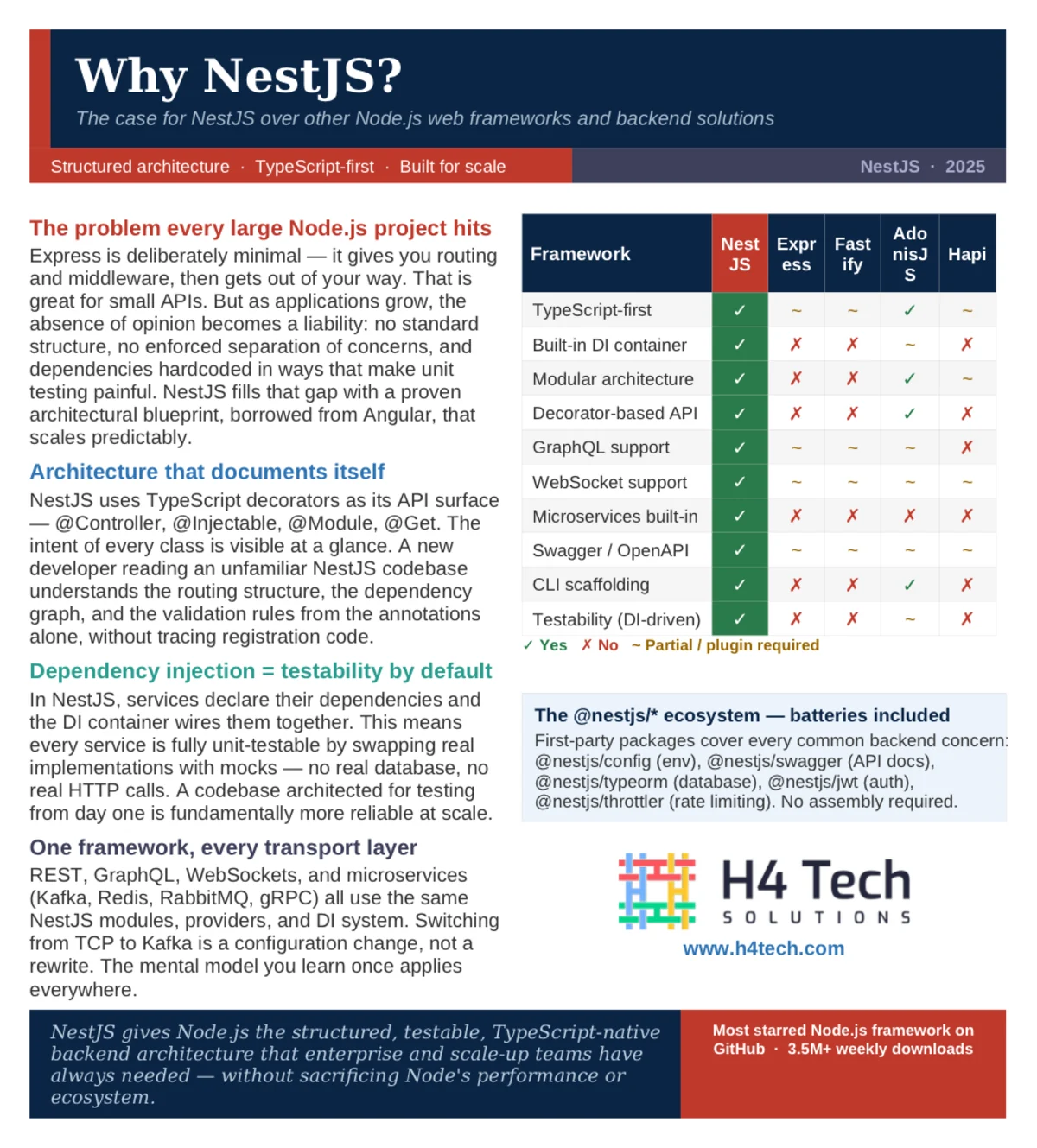
The problem every large Node.js project hits
Express is deliberately minimal — it gives you routing and middleware, then gets out of your way. That is great for small APIs. But as applications grow, the absence of opinion becomes a liability: no standard structure, no enforced separation of concerns, and dependencies hardcoded in ways that make unit testing painful. NestJS fills that gap with a proven architectural blueprint, borrowed from Angular, that scales predictably.
Architecture that documents itself
NestJS uses TypeScript decorators as its API surface — @Controller,
@Injectable, @Module, @Get. The intent of every class is visible at a
glance. A new developer reading an unfamiliar NestJS codebase understands the
routing structure, the dependency graph, and the validation rules from the
annotations alone, without tracing registration code.
Dependency injection = testability by default
In NestJS, services declare their dependencies and the DI container wires them together. This means every service is fully unit-testable by swapping real implementations with mocks — no real database, no real HTTP calls. A codebase architected for testing from day one is fundamentally more reliable at scale.
One framework, every transport layer
REST, GraphQL, WebSockets, and microservices (Kafka, Redis, RabbitMQ, gRPC) all use the same NestJS modules, providers, and DI system. Switching from TCP to Kafka is a configuration change, not a rewrite. The mental model you learn once applies everywhere.
How it compares
| Framework | NestJS | Express | Fastify | AdonisJS | Hapi |
|---|---|---|---|---|---|
| TypeScript-first | ✓ | ~ | ~ | ✓ | ~ |
| Built-in DI container | ✓ | ✗ | ✗ | ~ | ✗ |
| Modular architecture | ✓ | ✗ | ✗ | ✓ | ~ |
| Decorator-based API | ✓ | ✗ | ✗ | ✓ | ✗ |
| GraphQL support | ✓ | ~ | ~ | ~ | ✗ |
| WebSocket support | ✓ | ~ | ~ | ~ | ~ |
| Microservices built-in | ✓ | ✗ | ✗ | ✗ | ✗ |
| Swagger / OpenAPI | ✓ | ~ | ~ | ~ | ~ |
| CLI scaffolding | ✓ | ✗ | ✗ | ✓ | ✗ |
| Testability (DI-driven) | ✓ | ✗ | ✗ | ~ | ✗ |
✓ Yes ✗ No ~ Partial / plugin required
The @nestjs/* ecosystem — batteries included
First-party packages cover every common backend concern: @nestjs/config (env),
@nestjs/swagger (API docs), @nestjs/typeorm (database), @nestjs/jwt (auth),
@nestjs/throttler (rate limiting). No assembly required.
The bottom line
NestJS gives Node.js the structured, testable, TypeScript-native backend architecture that enterprise and scale-up teams have always needed — without sacrificing Node's performance or ecosystem.
Most starred Node.js framework on GitHub · 3.5M+ weekly downloads.